




— —
How to Select the Right H Beam Production Line: 7 Critical Parameters for Heavy-Duty Fabrication Plants
Selecting the Right H Beam Production Line: 7 Critical Parameters for Heavy-Duty Fabrication Plants
Selecting the right H beam production line is a mission-critical decision for heavy-duty fabrication plants—impacting throughput, structural integrity, and long-term ROI. It’s not about choosing the largest or most expensive system. It’s about matching machine behavior to your real-world workflow: the steel grades you handle daily, the section tolerances your clients demand, how often you switch between 200×200 and 800×300 profiles, whether your welders rely on pre-beveled edges or require post-processing flexibility—and how quickly your maintenance team can restore uptime after a hydraulic failure.
At Wuxi Armada International Trade Co., Ltd, we’ve supported over 140 fabrication facilities across Southeast Asia, Europe, and the Americas since 2012—not as equipment vendors, but as process partners. Our ISO9001- and CE-compliant H beam production line installations aren’t judged by catalog specs alone. They’re validated in shipyards where 40-mm-thick flanges must hold ±0.3 mm parallelism under continuous 16-hour shifts, or in container manufacturing plants where a single misaligned web cut triggers cascading rework across three downstream stations. That field experience reveals something counterintuitive: the most technically advanced line isn’t always the most productive one. The right line is the one whose parameters align with your operational reality—not just its theoretical capacity.
Capacity Range: Not Just Tonnes Per Hour
“Capacity” is routinely misread as maximum output speed. In practice, it’s the width of the stable operating window—the range of section sizes, thicknesses, and lengths where dimensional repeatability stays within specification without manual intervention. A line rated for “up to 30 tons/hour” may deliver only 18 tons/hour when processing 600×200×12×20 sections at ±0.5 mm web straightness, because feed rollers lose grip on thicker webs or shear blades deflect under asymmetric loads. True capacity must be verified at your most common profile mix—not the vendor’s demo piece.
We consistently see evaluators overlook minimum section limits. A line optimized for 1000×400 beams often struggles below 200×100 due to insufficient roller support density and inadequate guide rail rigidity. If your plant handles both structural columns and crane rails, demand test data across your full profile spectrum—not just peak performance points.
Section Accuracy: Where Tolerances Dictate Downstream Cost
Accuracy isn’t a static number stamped on a nameplate. It’s the cumulative effect of roller alignment stability, web/flange tension control, and thermal management during high-speed rolling. A deviation of ±0.8 mm in flange parallelism may seem minor—until you realize that every millimeter beyond ±0.4 mm forces your welding robot to compensate with adaptive path correction, slowing cycle time by 12–18% and increasing electrode consumption by 22%. Worse, it elevates rejection rates in certified structural work where EN 1090-2 mandates ≤0.5 mm flange taper per meter.
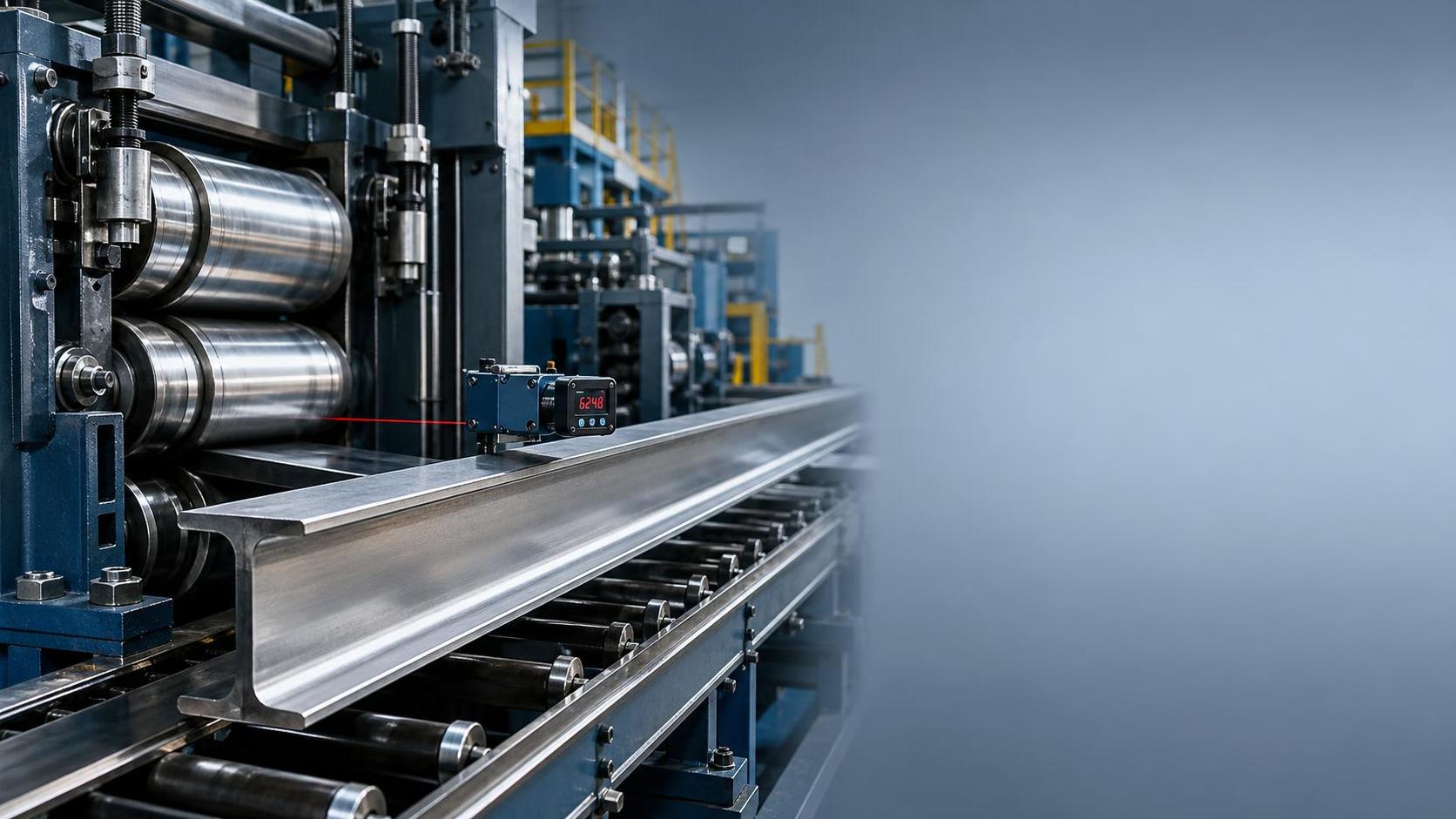
Look beyond initial calibration reports. Ask for longitudinal tracking data: how much does accuracy drift over an 8-hour shift? Does it recover automatically after a 15-minute cool-down, or require manual recalibration? Systems with integrated laser measurement loops—like those deployed in our European shipyard projects—maintain ±0.3 mm consistency for >12 hours without operator input. That’s not “precision engineering.” It’s predictable, repeatable fabrication.
Automation Level: Integration Depth Over Button Count
Don’t equate automation with touchscreen count. A line with 12 human-machine interfaces but no PLC-level integration with your ERP or MES system creates data silos—not efficiency. Real automation means the production line responds to material ID tags, adjusts feed speed based on real-time thickness measurement from ultrasonic sensors, and triggers automatic tool changes when cutter wear exceeds 0.15 mm—without operator confirmation.
Critical here is the interface with upstream and downstream processes. If your facility uses pre-cut plates, does the line accept plate length data directly from your CNC cutting machine’s G-code output? If your next station is automated welding, does the line export flange flatness and web perpendicularity metrics in OPC UA format? We’ve seen plants gain more throughput from seamless data handoff than from upgrading to a faster rolling mill.
Material Compatibility: Beyond “Carbon Steel Accepted”
Vendors list “carbon steel, stainless, aluminum”—but rarely specify what that means in practice. Stainless grades like S32205 behave differently than 304 under cold rolling: higher yield strength demands greater torque, while lower thermal conductivity risks localized work hardening. Aluminum alloys such as 6061-T6 require modified roller surface finishes and reduced roll pressure to prevent surface scoring—yet many lines use identical settings for all materials.
Ask for documented material-specific parameter sets—not generic recommendations. Verify whether the line includes quick-change tooling for different hardness ranges (e.g., hardened rollers for duplex stainless), and whether its cooling system prevents thermal distortion in high-conductivity alloys. In one Southeast Asian container plant, switching from carbon to AH36 required only software recalibration; moving to aluminum demanded mechanical retrofitting of feed guides—a cost not reflected in the initial quote.
Changeover Efficiency: Minutes Matter More Than Millimeters
A line that switches from 300×300 to 600×200 in 45 minutes isn’t “efficient” if your schedule requires six changeovers per shift. What matters is repeatability: can the same operator achieve sub-millimeter alignment consistency on the third changeover of the day? Look for systems with motorized, position-locked roller stands and laser-guided web centering—not manual micrometer adjustments. In shipbuilding applications, where profile mixes shift hourly, lines with pre-loaded tooling presets cut average changeover from 38 to 9 minutes—directly enabling mixed-profile batch runs instead of segregated production blocks.
Safety Compliance: Beyond CE Stickers
CE marking confirms baseline conformity—but doesn’t guarantee safe operation in your environment. A CE-certified line may meet EN ISO 13857 clearance distances, yet still place emergency stops outside reach of operators wearing arc-flash PPE gloves. Or its hydraulic reservoir might exceed EN 60204-1 temperature limits when ambient workshop temps hit 42°C—triggering unannounced shutdowns.
Require site-specific risk assessment documentation: how were pinch points evaluated for your typical operator height and PPE configuration? Is lockout-tagout (LOTO) accessible without disassembling guarding? Does the control architecture support Category 3 PLd per EN ISO 13849-1 for critical functions like roller reversal? These aren’t compliance checkboxes—they’re uptime safeguards.
Serviceability: The Unspoken ROI Driver
A line’s serviceability determines whether a bearing replacement takes four hours or two days. Key indicators: modular component design (e.g., roller assemblies that lift out as single units, not requiring disassembly of adjacent shafts), standardized fasteners (no proprietary bolts), and diagnostic port accessibility—even with guards installed. In one North American bridge fabricator, service time dropped 65% after replacing a legacy line with one featuring plug-and-play hydraulic manifolds and onboard vibration analysis that isolates failing components before catastrophic failure.
Also assess spares logistics. Does the vendor stock critical wear parts regionally—or do you wait 45 days for a custom-machined guide rail? At Wuxi Armada, we maintain strategic spares hubs in Rotterdam, Singapore, and Houston precisely because downtime costs far exceed hardware investment. That’s why every CNC Square & Pipe Beveling Machine we supply includes field-serviceable cutter heads and heat-treated guide rails designed for rapid disassembly—because bevel quality depends on consistent tool geometry, not just initial setup.
None of these seven parameters operate in isolation. A line with exceptional section accuracy loses value if changeover eats half your scheduled time. High automation fails if serviceability traps you in multi-day repairs. Your evaluation shouldn’t start with brochures—it should begin with a walk-through of your shop floor: watch how operators handle material transfers, note where welders pause to manually adjust fit-up, time how long it takes to verify dimensions on the first piece of a new run. That’s where the real H beam production line requirements live—not in spreadsheets, but in the rhythm of your production flow.
