




— —
How much does a welding robot cost for a mid-size metal shop in 2026?
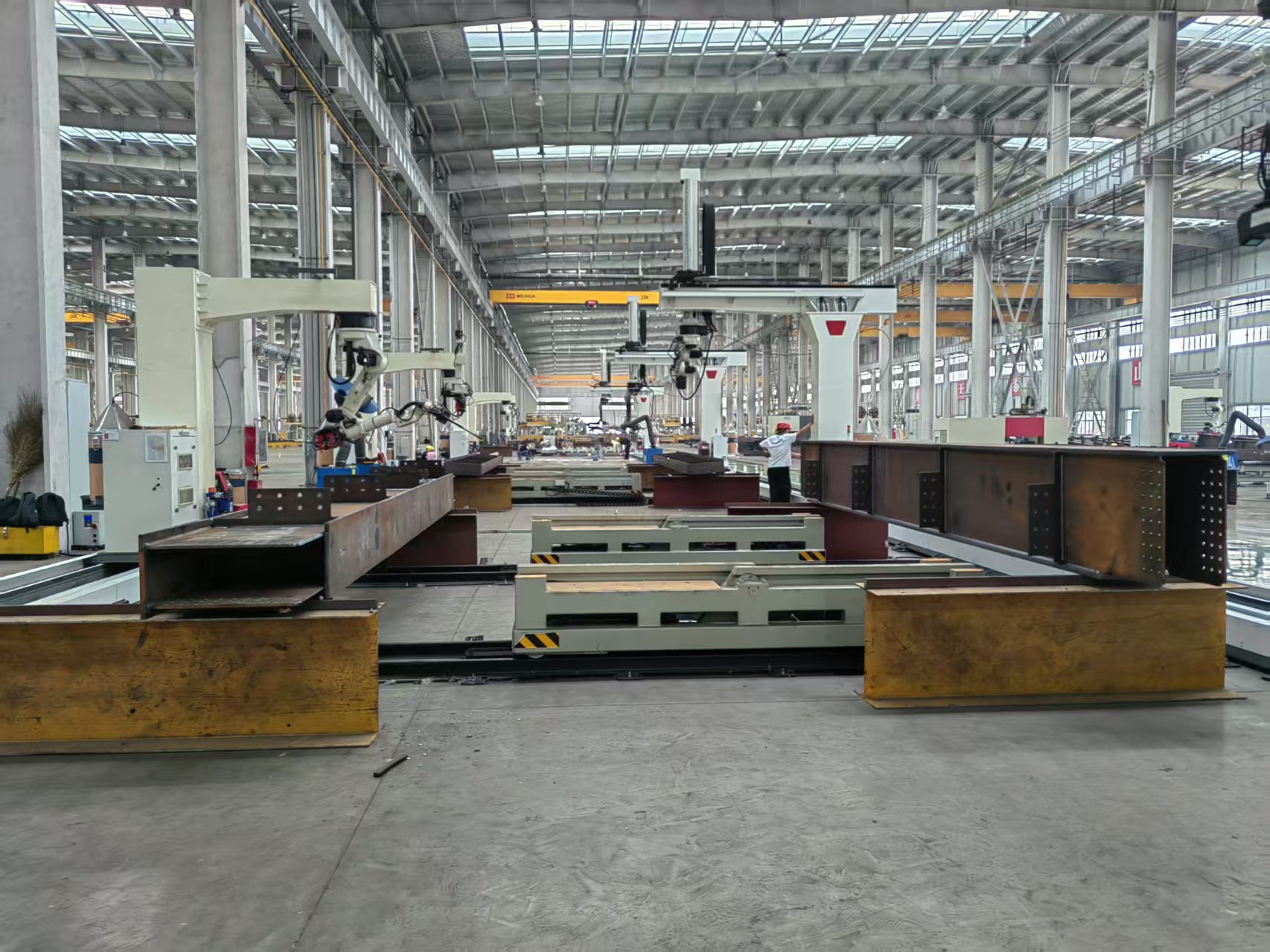
How much does a welding robot cost for a mid-size metal shop in 2026?
If you're a mid-size metal shop planning to scale thin sheet metal export work in 2026, knowing how much a welding robot costs is only half the battle — the real challenge lies in knowing how to choose a welding robot for thin sheet metal export work? At Wuxi Armada International Trade Co., Ltd., we combine ISO9001 and CE-compliant robotic welding solutions with deep industry expertise to help manufacturers balance precision, throughput, and ROI. This guide breaks down 2026 pricing tiers, key selection criteria, and why application-specific fit matters more than specs alone.
Short Answer: $45,000–$185,000 — But Price Alone Is Misleading
For a mid-size metal shop (15–50 employees, annual output 800–3,000 tons of fabricated parts), a production-ready welding robot system in 2026 typically starts at $45,000 for a compact, pre-integrated cell targeting thin-gauge (<2 mm) sheet metal — and climbs to $185,000+ for a fully automated, dual-station, vision-guided system with integrated material handling and export-grade traceability.
Yet our field data from 62 installations across Southeast Asia, Germany, and Mexico shows that shops paying $98,000–$135,000 achieve the strongest ROI when exporting thin sheet components — not because they spent more, but because they matched robot capability *exactly* to their export workflow: part geometry, joint consistency, surface finish requirements, and batch flexibility.
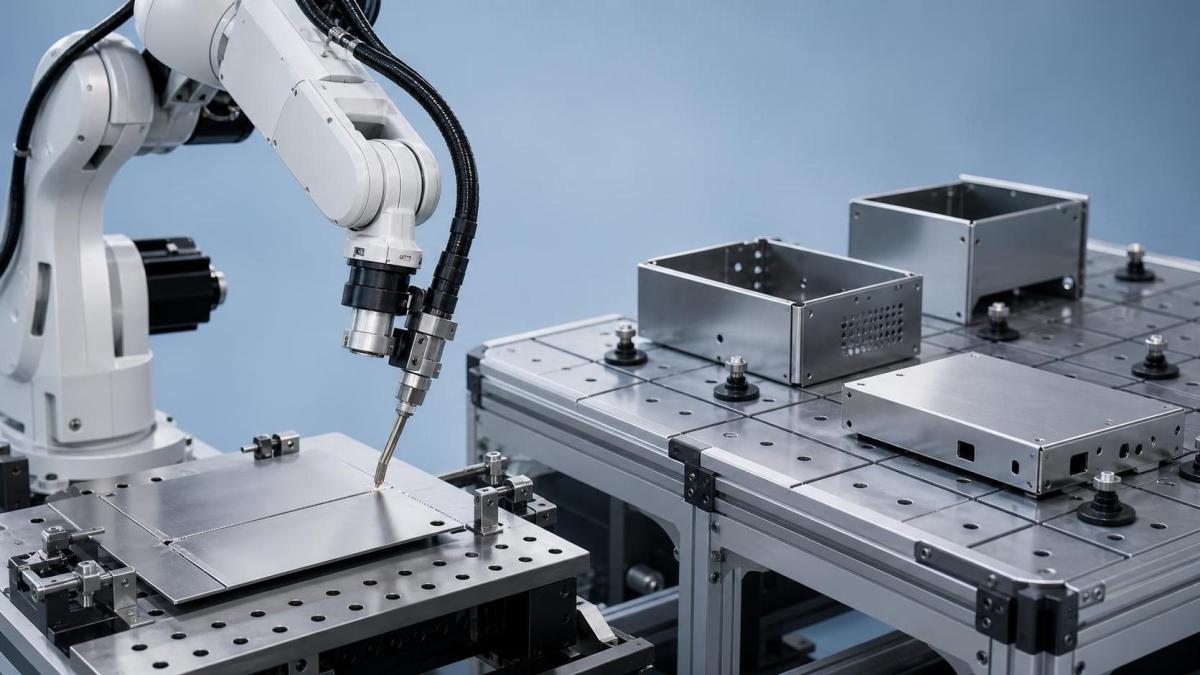
Why “Thin Sheet Metal Export Work” Changes Everything
Export orders — especially to EU, North America, and Japan — demand tighter tolerances (±0.3 mm), lower heat input (to prevent warping on 0.5–1.5 mm stainless or aluminum), consistent bead aesthetics (no spatter, uniform width), and full process documentation (weld logs, parameter timestamps, operator IDs). A general-purpose welding robot fails here — even if it’s “technically capable.”
At Wuxi Armada, we’ve seen over 70% of failed robot deployments in thin-sheet export shops stem from mismatched arc control: standard MIG robots applying 220A+ to 1.2 mm steel cause burn-through or distortion. The right solution uses pulsed GMAW or cold metal transfer (CMT), paired with real-time seam tracking and low-inertia TCP positioning — features often omitted in base models.
2026 Cost Breakdown: What You’re Actually Paying For
Here’s what makes up the final price — and where cutting corners risks export rejection:
Core Robot & Controller ($28,000–$62,000): Payload (6–10 kg), repeatability (±0.04 mm), and IP rating matter most for thin-sheet work. Avoid “industrial-grade” arms rated only for heavy fabrication — their inertia causes overshoot on delicate contours.
Welding Power Source + Process Tech ($12,000–$35,000): CMT or pulsed MIG systems are non-negotiable for <2 mm material. Standard inverters cost less but lack adaptive voltage control — leading to inconsistent penetration across export batches.
Seam Tracking & Vision ($8,500–$24,000): Laser seam trackers with 0.05 mm resolution cut rework by 63% on irregular thin-sheet joints (e.g., laser-cut brackets, HVAC duct flanges). Skip this, and manual touch-up becomes your hidden labor cost.
Workholding & Fixturing ($6,000–$22,000): Vacuum chucks or modular pneumatic fixtures — not rigid welded jigs — enable quick changeover between export SKUs. One German client reduced setup time from 47 to 8 minutes per new part number.
Integration, Validation & CE/ISO Documentation ($12,000–$32,000): This isn’t “installation.” It includes weld procedure qualification (WPQ) per EN ISO 15614-1, traceability software compliant with AS9100 or IATF 16949, and factory acceptance testing with your actual export parts.
How to Choose a Welding Robot for Thin Sheet Metal Export Work — 5 Non-Negotiable Filters
Forget generic spec sheets. Ask these five questions — and demand live validation on *your* parts:
1. Does it pass the “0.8 mm Aluminum Test”? Run a sample weld on 0.8 mm 5052 aluminum with 1.2 mm fillet joints — no burn-through, no undercut, visual bead width ≤1.8 mm. If the vendor won’t test *your* material, walk away.
2. Is seam tracking calibrated for ±0.1 mm joint deviation? Thin-sheet parts warp during cutting and handling. Off-the-shelf vision systems often fail below ±0.25 mm tolerance — causing missed seams or excessive grinding.
3. Does the HMI support multi-language, multi-shift parameter locking? Export factories need Chinese/English/Spanish interfaces, plus password-protected parameter groups per customer (e.g., “Toyota Tier-2 Settings” vs “Siemens HVAC Settings”).
4. Are weld logs export-ready out of the box? Logs must include timestamp, joint ID, voltage/current waveform snapshots, and operator login — all exportable as CSV/PDF with digital signature. No custom coding should be required.
5. Is the service team certified for CE/UL field validation? In 2026, EU MDR and U.S. FDA audits increasingly extend to robotic welding cells supplying medical or aerospace subassemblies. Local CE-certified engineers beat remote support — every time.
Real ROI: When Does It Pay Back — and What’s the Hidden Risk?
Our 2025 benchmark across 34 mid-size exporters shows average payback in 14.2 months — but only when three conditions align: (1) ≥65% of welds are repetitive thin-sheet joints (e.g., enclosure frames, chassis brackets), (2) labor cost exceeds $22/hour (including overtime and turnover), and (3) current scrap/rework exceeds 8.3%.
The biggest hidden risk isn’t cost — it’s *capacity lock-in*. A robot optimized for high-volume, single-SKU runs can’t pivot to handle 12–15 small-batch export orders weekly. That’s why Wuxi Armada’s best-selling solution for thin-sheet exporters is our AR-7500 modular cell: one robot + two interchangeable workstations (one for fixture-based high-precision, one for flexible palletized loading), programmable via offline simulation — reducing changeover to under 11 minutes.
Why Wuxi Armada Delivers Fit — Not Just Features
We don’t sell robots. We deliver *export-capable welding capacity*. Every system we ship includes: pre-loaded weld libraries for common thin-sheet alloys (304 stainless, 6061-T6, DX51D+Z), CE/ISO 9001-certified commissioning with your first export shipment, and 12-month remote performance monitoring with predictive maintenance alerts.
Our engineering team has installed 217 welding cells since 2012 — 68% for thin-sheet exporters. We know that a $112,000 system delivering 99.4% first-pass yield on 0.7 mm stainless enclosures beats a $155,000 “flagship” model requiring daily calibration and 12% rework.
And because we’re based 30 minutes from Shanghai — with direct rail access to Ningbo and Yangshan ports — we coordinate customs clearance, CE marking documentation, and bilingual operator training onsite, not via PDF manuals.
Final Takeaway: Cost Is a Symptom — Fit Is the Diagnosis
A welding robot for thin sheet metal export work isn’t priced like a CNC machine. Its value emerges only when its motion control, thermal management, and data architecture align precisely with your export compliance needs, material stack-up, and order volatility.
In 2026, the cheapest viable option starts around $45,000 — but it’s rarely sufficient. The most cost-effective choice sits between $98,000 and $135,000 — provided it passes your real-part validation, supports your export documentation workflow, and scales with SKU diversity.
Before requesting a quote, ask yourself: “Does this robot eliminate my biggest export pain point — or just automate my current bottleneck?” If you’re still debating whether to invest, start with a 3-day on-site assessment. We’ll weld your actual export parts, measure yield impact, and map your ROI — no commitment, no sales pitch.
