




— —
What should you verify before buying a China 7 axis welding robot?
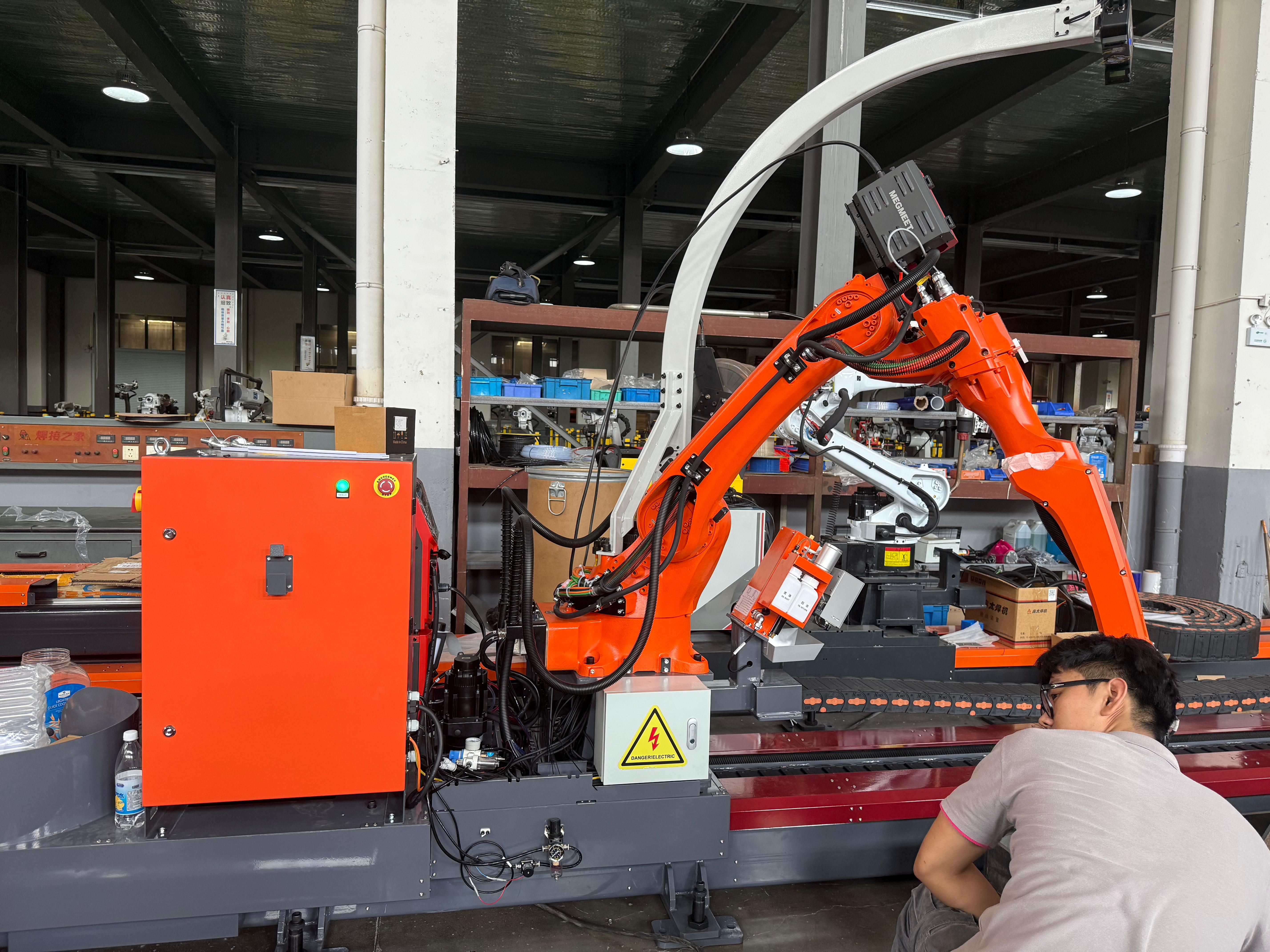
A welding cell can look suitable on a quotation and still become difficult to commission once it reaches the factory floor. The usual pressure point is not the robot’s headline payload; it is whether the arm can approach every joint, maintain the required torch angle, communicate with the existing welding power source, and operate safely around fixtures, operators, and material flow.
Before buying a China 7 axis welding robot, verify the complete working system rather than the robot alone. The most important checks are reach and axis freedom at real weld locations, repeatability under load, controller and welder integration, safety design, documentation, acceptance testing, service response, and the availability of consumable and replacement parts. A lower purchase price has little value if the cell requires major rework after delivery or cannot maintain production when a sensor, cable, or reducer needs replacement.
Start with the actual weld path, not the robot brochure
A seven-axis robot is normally selected because the extra axis gives more freedom to work around obstructions, maintain a useful torch angle, or reach joints from positions that a conventional six-axis arm may struggle to access. That advantage only exists when the motion has been checked against the real workpiece, fixture, torch package, and surrounding equipment.
Ask the supplier to assess the parts that will actually be welded. A drawing is useful, but it may not show clamps, locating pins, tack welds, part variation, cable interference, or the clearance needed for a torch cleaning station. For structural frames, fabricated housings, pipe assemblies, and multi-sided components, a path that looks reachable in a static layout can still force the wrist near a singularity or create an awkward cable bend during motion.
Prepare representative part information before discussions begin:
- Overall dimensions, weight, material grade, thickness range, and expected part variation.
- Joint types, weld positions, root gaps, fillet sizes, seam lengths, and access restrictions.
- Required throughput, shift pattern, batch size, and whether mixed models will use the same cell.
- Fixture concept, loading method, part orientation, and space for clamps to open safely.
- Welding process requirements, including MIG/MAG, TIG, plasma, or other specified methods.
The review should identify which joints need the seventh axis. It is reasonable to question a proposal that adds axis complexity without solving a documented access or orientation problem. Conversely, rejecting the extra axis based only on a basic reach calculation can create recurring limitations when the product mix changes.
Check usable reach, payload, and wrist loading together
Published maximum reach does not equal usable reach. The outer edge of a robot’s envelope may provide limited speed, unfavorable joint posture, or insufficient torch orientation. Request a reach study showing the complete path, not only a dot placed near a target location. It should include approach and retreat moves, the widest workpiece condition, and the planned positioner or turntable angles.
Payload needs similar scrutiny. The robot may carry a torch, wire feeder mounting bracket, dress pack, cable package, seam-tracking sensor, and sometimes additional process equipment. The relevant calculation is not merely their combined mass. It also includes the center of gravity and the moment applied to the wrist. A torch assembly mounted far from the flange can create a higher load moment than its weight alone suggests.
Ask for confirmation of the approved payload at the intended center of gravity and orientation. This becomes especially important where long-neck torches, heavy-duty reamers, laser seam sensors, or external-axis dress packs are planned. An underspecified wrist may still function during short demonstrations but can lose positioning stability or reduce component life under continuous production cycles.
Do not treat repeatability as a substitute for weld quality
Robot repeatability describes how consistently the machine returns to a programmed position. It does not guarantee that the seam is where the program expects it to be. Weld quality also depends on fit-up, fixture rigidity, part distortion, torch condition, wire feeding, shielding gas, electrical grounding, and process parameters.
This distinction matters when a buyer expects automation to compensate for inconsistent incoming parts. A robot repeats motion very well; it does not automatically correct a changing joint gap or a component that shifts in a fixture. Where variation is unavoidable, discuss whether the application needs touch sensing, wire touch search, through-arc seam tracking, laser seam finding, adaptive programming, or additional fixturing controls. Each option has limits. Sensors can help locate a seam, but they cannot make severely distorted parts weld like accurately prepared parts.
Request a clear statement of what the proposed system can detect and what it cannot. For example, touch sensing may identify a repeatable reference edge before welding, while a seam-tracking system may follow a weld joint during travel. These are different functions, with different calibration needs and different effects on cycle time.
Examine the welding package as carefully as the robot arm
A robot manufacturer, welding power source provider, integrator, and fixture builder may all be involved in one project. Problems arise when responsibility for the interface is unclear. Procurement documents should define who supplies, connects, tests, and supports each element of the cell.
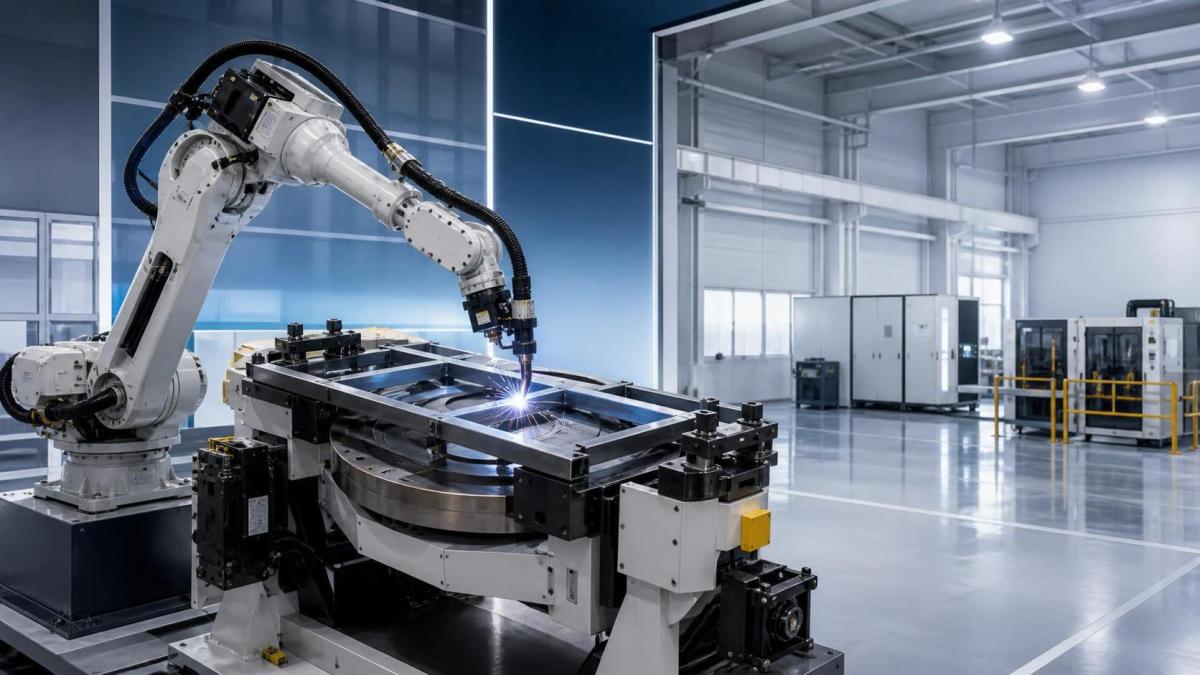
Confirm the welding power source model, its communication method, the availability of synergic programs if relevant, and which parameters can be called from the robot program. The controller should be able to manage the required welding sequence, including gas pre-flow, arc start, crater fill, wire retract, and post-flow where applicable. Ask whether the proposed interface supports fault reporting that operators can understand rather than a generic alarm that requires several phone calls to diagnose.
The torch and wire-feed arrangement deserve a practical review. Check cable routing over the full robot movement, bend radius, protection against hot spatter, and access for replacing liners, contact tips, nozzles, and necks. A dress pack that is poorly matched to the robot’s seventh-axis motion can twist, snag, or wear prematurely. Confirm the proposed torch cleaning station, anti-spatter process, wire cutter arrangement, and the method for checking the torch center point after a collision or maintenance event.
Match the cell to the factory’s upstream preparation
Welding automation often exposes weaknesses in material preparation. Burrs, inconsistent edge condition, heavy mill scale, poor forming accuracy, and unstable profiles can lead to variable fit-up before the robot begins its cycle. In fabrication lines handling curved or asymmetric sections, the quality of upstream bending may influence fixture repeatability as much as robot programming does.
Where profiles are formed before assembly, equipment such as a Profile bender can be relevant to maintaining controlled pre-bending, coiling, rounding, and calibration operations. Its hardened rolls, hydraulic movement, digital displacement display, and adjustable guides are features that may support repeatable forming work, but buyers should still confirm the final profile geometry against their own welding fixture and tolerance requirements. The key point is to evaluate the production route as a connected process, not as isolated machines.
Review controller capability and plant integration
The controller must support more than robot motion. It needs enough input/output capacity and communication capability for safety devices, positioners, clamps, sensors, welding equipment, fume extraction interlocks, and potentially plant-level monitoring. List the interfaces required before comparing offers. A cell with a rotary positioner, dual stations, or external linear track can require substantial coordination between axes and safety zones.
Ask which programming environment is provided, who receives training, and whether source programs can be backed up locally. Access to backups matters because recovery after a controller fault, collision, or unauthorized edit should not depend solely on a remote supplier. Clarify user permissions as well: operators may need restricted access for recipe selection and recovery, while authorized technicians require access for calibration and program adjustments.
When production traceability is required, determine what data can be exported. Useful records may include program identification, weld parameter status, alarm history, cycle state, and operator-selected part recipe. Do not assume that a controller advertised as network-capable will automatically communicate with existing manufacturing systems. Compatibility, protocol, cybersecurity controls, and responsibility for commissioning should be agreed in writing.
Make safety design a purchasing requirement, not an optional add-on
A seven-axis welding cell introduces moving machinery, hot work, arc radiation, fumes, electrical hazards, and pinch points around fixtures or positioners. Safety cannot be assessed from a robot specification sheet alone. Request a cell layout that shows fencing, access doors, interlocks, emergency stops, safe loading zones, cable routes, and the location of service access.
Pay close attention to the practical recovery situation. An operator may need to enter the cell after a misfeed, a torch collision, or a wire fault. The proposed design should explain how the cell enters a safe state, how motion is controlled during recovery, and how restart is prevented until required conditions are met. Safety devices should be compatible with the destination market and the project’s applicable requirements; the buyer should confirm the exact compliance obligations for the installation location rather than relying on a broad statement of conformity.
Fume extraction also needs a defined interface. The supplier should state whether ducting, extraction hoods, airflow confirmation, and interlocking are included or excluded. Welding fumes that remain in the enclosure may affect visibility, maintenance intervals, and working conditions even when the robot itself operates normally.
Test the proposed solution before shipment
A factory acceptance test should be based on agreed conditions, not a brief demonstration of the robot moving through an empty cycle. Before placing the order, define what will be tested, what materials and parts will be used, who provides them, and what constitutes a pass or an open issue.
The test scope should reflect the risks of the application. For a production welding cell, this can include weld-path execution on representative components, arc-start consistency, positioner coordination, sensor operation where included, safety interlock function, alarm recovery, and verification of the stated cycle assumptions. Weld appearance alone may not establish suitability. The acceptance plan should specify any required inspection method, the applicable quality criteria, and whether sample sections or additional testing are needed.
It is also useful to define the site acceptance stage separately. Shipping, installation, power supply, gas supply, local guarding modifications, and fixture alignment can change the result after delivery. A site acceptance process should state which party is responsible for commissioning, what training is included, how punch-list items are handled, and when final handover occurs.
Ask questions that reveal service capability
After-sales support is often evaluated too late. Before ordering, request a parts list that separates normal consumables from recommended critical spares. The list should cover robot batteries where applicable, cable assemblies, motors or reducers if recommended, controller-related components, torch consumables, sensors, and components used in the wire-feed and cleaning system. Ask where these items are stocked and how part numbers are controlled.
Remote support can shorten troubleshooting time, but it does not replace clear documentation or local maintenance capability. Confirm the language of electrical drawings, pneumatic diagrams, manuals, parameter records, backup files, and fault codes. Determine whether remote access requires a particular network setup and whether the buyer can approve or disable it according to plant policy.
Training should be separated by role. Operators need safe startup, shutdown, part loading, recipe selection, routine torch care, and basic alarm response. Maintenance personnel need preventive maintenance schedules, backup restoration, calibration checks, cable inspection, and fault isolation. Programmers or process engineers need instruction on editing paths, changing parameters within approved limits, managing tool data, and validating changes before production resumes.
Use the quotation to expose exclusions early
Compare quotations line by line, not only by total price. One proposal may include a robot arm and power source while another includes fencing, positioners, fixture interfaces, cleaning equipment, programming, installation support, and training. A lower-cost offer may be valid, but only if the buyer understands what must still be sourced, engineered, or installed.
Ask each supplier to identify the boundaries of supply. Typical points that require clarification include fixtures, foundation work, electrical distribution, shielding gas lines, extraction ducting, workpiece loading equipment, external-axis commissioning, spare parts, travel expenses, acceptance testing, and software modifications after handover. The more complex the cell, the more important this boundary document becomes.
The strongest purchasing decision is usually the one supported by a realistic part review, verified interface responsibility, written acceptance criteria, and a service plan that can be used after the equipment arrives. A China 7 axis welding robot should be selected because it can perform the required paths reliably within the complete production system—not simply because its catalogue specifications appear competitive.
