




— —
Flat Die Thread Rolling Machine: Key Parameters for Stable Production Quality
Why Process Stability Matters in Thread Rolling
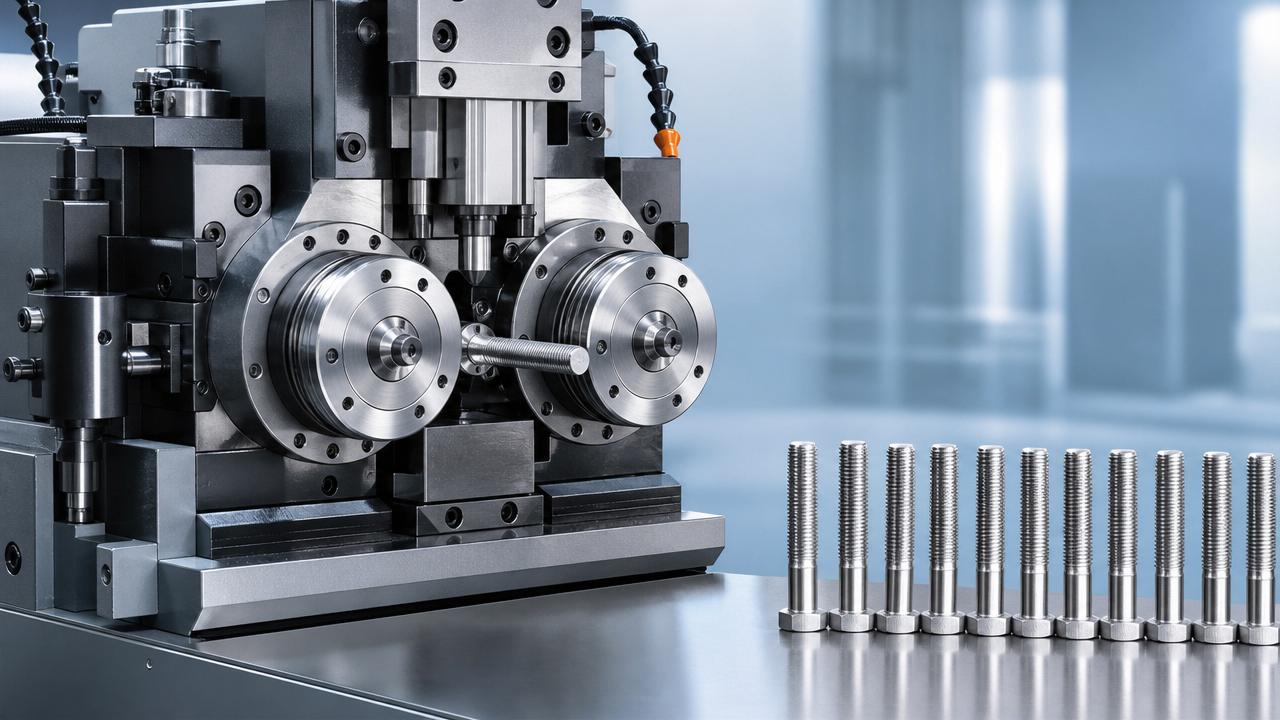
A Flat die thread rolling machine shapes threads through pressure, not cutting, so quality depends on process balance more than on a single setting.
That is why stable production quality becomes a daily concern in metalworking lines handling fasteners, shafts, studs, and similar parts.
When alignment, pressure, and material behavior stay within a controlled range, threads remain consistent, surface finish improves, and scrap rates stay lower.
When those factors drift, defects appear quickly. Pitch variation, incomplete forming, surface marks, and unsafe machine loads often come from small process deviations.
In manufacturing and processing machinery, this matters because downstream assembly, coating, and fatigue performance all depend on thread integrity.
For operations working to ISO9001 and CE-oriented expectations, repeatability is not only a quality issue. It is also a safety and traceability issue.
What a Flat Die Thread Rolling Machine Must Control
The core principle is simple. Two flat dies compress and displace material to generate the thread profile on the workpiece surface.
In actual production, the result depends on how evenly that force is applied from entry to exit.
A reliable Flat die thread rolling machine must control several linked variables at the same time:
- die geometry and wear condition
- parallelism and alignment of the dies
- rolling pressure and contact progression
- blank diameter and material hardness
- machine rigidity, vibration, and feed consistency
- lubrication, cleanliness, and operator setup discipline
If one variable changes, others react. That is why stable quality comes from system control, not from isolated parameter adjustments.
Parameters That Directly Influence Thread Accuracy
Some parameters affect appearance. Others affect whether the thread will pass gauging, torque, or service-life requirements.
Die alignment and parallelism
Poor alignment is one of the fastest ways to lose control. It can produce uneven thread depth, side loading, and premature die damage.
Even slight angular error changes material flow. The workpiece may enter correctly but leave with inconsistent flank form or pitch distortion.
Rolling pressure
Pressure must match material grade, blank size, and thread specification. Too little pressure causes incomplete formation.
Too much pressure creates over-rolling, stress concentration, surface tearing, or abnormal load on the machine structure.
Blank diameter and material consistency
Thread rolling is sensitive to incoming variation. If the blank diameter shifts beyond tolerance, the formed thread will also shift.
Material consistency matters in the same way. Different hardness levels change flow resistance, contact load, and final thread shape.
Machine rigidity and vibration
A Flat die thread rolling machine with weak structural rigidity cannot hold precision under continuous load.
Vibration often appears first as surface marks or noise. Later, it leads to unstable dimensions and higher maintenance frequency.
Where Quality Problems Usually Begin
In many workshops, defects are blamed on the machine too early. In reality, problems often start in preparation and control discipline.
This is why process records matter. A stable Flat die thread rolling machine should be supported by stable incoming inspection and setup verification.
Related Upstream and Downstream Factors
Thread quality is affected by more than the rolling station itself. Surface condition before rolling can strongly influence consistency.
Oxide scale, rust, and embedded contamination can damage dies or interfere with smooth material flow during forming.
In steel structure and fabricated part processing, surface preparation equipment often supports better forming stability across the line.
For example, Shot blasting machine solutions are commonly used in metallurgical and casting industries to remove rust, scale cinder, and surface contamination.
A Q034 configuration can handle workpiece sections up to 800×1600 mm, lengths up to 15000 mm, and uses a Mitsubishi PLC with dust removal support.
That kind of upstream cleanliness control helps create a more uniform surface, which supports later coating quality and process reliability.
The connection is practical rather than promotional. Stable production usually comes from coordinated equipment, not from one machine working alone.
How the Industry Is Evaluating Equipment Today
The discussion is no longer limited to output speed. Buyers and plant teams are comparing equipment by process stability over time.
This shift is especially visible in export-oriented production, where thread conformity, documentation, and machine safety all affect delivery confidence.
Wuxi Armada International Trade Co., Ltd has operated in this environment since 2012, supplying a broad range of fabrication and machining equipment.
Its portfolio covers thread rolling machines, CNC machine tools, welding systems, cutting equipment, plate processing lines, and beam production solutions.
That wider equipment perspective matters because thread rolling performance is easier to judge when it is viewed as part of the full manufacturing chain.
ISO9001-based organization and CE-oriented design expectations also make parameter control more visible, from initial setup to repeat production batches.
Practical Checks for Stable Daily Operation
A Flat die thread rolling machine performs best when checks are simple, repeatable, and linked to actual defect patterns.
- Verify die mounting, parallelism, and contact path before each production run.
- Confirm blank diameter, hardness, and surface condition by lot, not only at startup.
- Track lubrication condition and contamination around the die area.
- Listen for abnormal vibration, impact, or load fluctuation during continuous operation.
- Use thread gauges together with visual surface checks, not as separate activities.
- Record parameter changes and correlate them with defect rates and die life.
Usually, the most useful improvement is not a dramatic redesign. It is better control of small variables that repeat every shift.
A Better Basis for Evaluation
Choosing or improving a Flat die thread rolling machine should begin with a process map rather than a catalog comparison.
Look at the material range, thread standards, lot variation, required throughput, inspection method, and the condition of upstream preparation steps.
Then compare machine rigidity, adjustment precision, die change repeatability, guarding, and maintenance accessibility against those needs.
That approach gives clearer answers than focusing only on nominal capacity or initial cost.
Where production quality is already unstable, the next useful step is often a parameter review sheet tied to actual defect samples and maintenance records.
With that baseline, it becomes easier to decide whether the issue lies in setup discipline, material control, machine condition, or line integration.
